Folded or Hung: Choosing a Home for Fabric Shopping Bags
Choose where fabric shopping bags belong by comparing a folded container with a hanging point, so the setup fits your space and leaving routine.
A fabric shopping bag draped over the kitchen chair is easy to see and inconvenient to sit on. Put it in a drawer and the chair clears, but the bag may be absent from mind when you leave. Choosing where to keep fabric shopping bags is a small household planning problem: the right arrangement makes them easy to store and easy to retrieve without creating another pile.
Most homes need to settle two questions. Is there a useful container or hanging point near the door, and will people in the household notice and use it? Folding bags into one container and hanging them near an exit solve these questions differently. A hybrid can work too, provided it has a clear purpose rather than becoming a polite name for putting bags everywhere.
Folded fabric shopping bags make a contained store
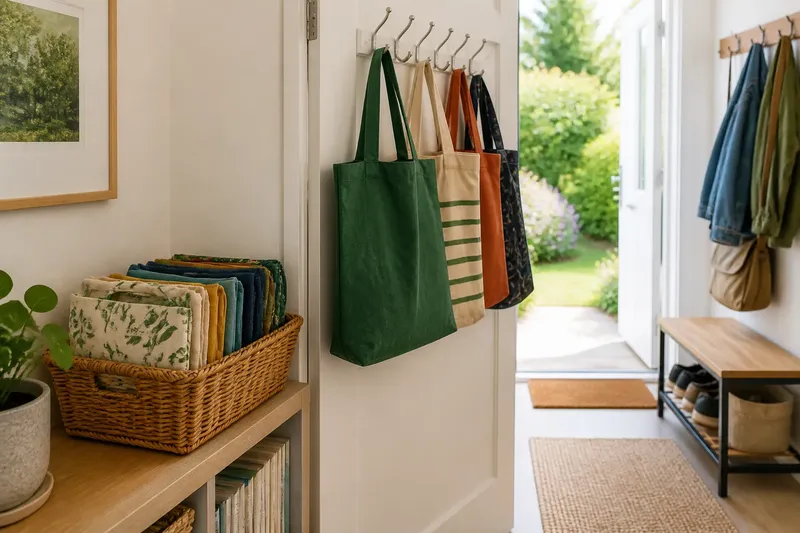
A basket, lidded box, spare tote or drawer can hold bags folded together. The arrangement keeps loose handles and corners from spreading across a shelf, and the container can be moved for cleaning or to make room. It is especially useful where a wall hook would interrupt a narrow passage or where the entrance has no suitable hanging point.
Choose a container that is already available before assigning the bags a new home. A shallow basket on a hall shelf may make more sense than buying a storage box that needs its own storage plan. If a drawer is the chosen place, it should open easily and have enough room for the bags without forcing them into a dense lump.
Folding can help keep bags tidy, but precision is optional. Flattening each bag and folding it into a manageable shape is usually enough; elaborate folds are a fragile system if several people are expected to maintain them. Handles can be tucked in loosely to stop them catching on the container edge.
The main drawback is reduced visibility. A closed drawer conceals the bags, and even an open basket can become less useful if it sits behind coats or mail. A container works best when its location is both obvious and easy to reach, not merely close to the door in the abstract.
Keep the container close enough to the household’s ordinary route out that retrieving a bag does not require a detour.
Hanging bags puts them in view
A row of hooks on a suitable wall, the inside of a cupboard door, or an existing coat rail keeps bags visible and ready to lift. Hanging also allows dampness or odour to clear more readily than packing a bag tightly into a closed container, although bags should be clean and dry before long-term storage. A single hook can hold several bags, but a crowd of handles may make it awkward to take just one.
This arrangement suits a household that passes the same exit regularly and responds to visible reminders. It can be useful when bags are used by different people, since nobody has to remember which drawer contains them. The bags remain easy to count at a glance, too, which can help prevent a slow accumulation of extras.
Visibility costs wall space. A hook in a cramped hall can catch sleeves, bags or passing shoulders, and fabric colours and logos may add visual clutter. An inside cupboard door keeps the bags out of sight when the door is shut, but only helps if that cupboard is near the route out and is not already difficult to open.
Hooks should suit the surface and the weight they will carry. If fitting a new hook involves work on a wall or door, choose an appropriate product and follow its instructions; for anything involving a building, electrical or other safety concern, ask a qualified person.
Use hanging storage where the bags can be seen without turning the entrance into an obstacle course.
A small hybrid can separate spare bags from ready bags
Some households benefit from keeping only the bags likely to be used soon on a hook, with the rest folded in a basket or drawer. That gives the visible arrangement a limit while leaving additional bags accessible. It is a sensible middle course when one or two bags regularly accompany someone out, but a larger supply is needed for occasional shopping trips.
A hybrid needs a boundary. If the hook is for bags going out and the container is for clean spares, those roles are easy to understand. If every bag migrates between both places, the extra arrangement adds work without resolving the original choice.
Say you leave through a narrow hall, carry one bag most weekdays, and use several more only for a larger shop. You might hang the frequently used bag inside a cupboard door near the exit and fold the remaining bags into an existing basket on a shelf. The expected observable result is that the everyday bag is visible at the point of departure while the spares stay contained and do not crowd the hall.
That division is not mandatory. A home with a broad entrance and frequent group shopping may have no reason to keep a reserve separate, while someone using a single compact bag may find a hybrid unnecessarily fussy.
The entrance and the household routine decide which fits
Look at the actual route people take rather than choosing a location because it seems tidy on its own. Someone who leaves through a back door may not benefit from bags stored in the front hall. A container under a bench is convenient only if the bench remains accessible, and hooks by the door help only if people pass them before they are already outside.
Consider how different members of the household take and return bags. A shared basket can suit people who prefer to pick a bag as needed. Hooks can be clearer for a household where each person tends to carry a particular bag, provided the hooks are not treated as permanent personal storage for coats and other items.
Small spaces call for attention to the shape of the storage, not just its footprint. A slim container on an existing shelf may use otherwise idle space, while a hook behind an open door can be hidden from view without occupying a floor surface. In a busy entry, however, even a compact hook may catch a strap or sleeve. Check how doors swing and how people pass before assigning the spot.
Think about the bags themselves as well. Bulky canvas bags take more room when folded than thin nylon ones, while long handles may hang too low on a short hook. A mixture of sizes may be easier to manage when folded into a container than when several different handles dangle together.
Choose the place that fits the route people already use, rather than expecting everyone to adopt a new route for the bags.
Which storage choice suits your home?
Is a basket or drawer better for fabric shopping bags?
A basket makes the bags visible and easy to lift out, while a drawer keeps them concealed and may suit an entrance where open storage looks cluttered. Pick the one that is easiest to reach and large enough for the bags without making them hard to retrieve.
Are hooks a good choice for a small hallway?
Hooks can free a shelf or floor area, but they are not automatically space-saving if bags project into a narrow walkway. A hook inside a cupboard door or on an existing rail may be a better fit, provided people use that door or rail on the way out.
How many bags should stay near the exit?
Keep the number that the household can use without crowding the chosen spot. If the hook or container fills with bags that rarely leave the house, keep only the likely-to-be-used ones there and move the rest to a defined spare-storage place.
Should shopping bags be stored folded or unfolded?
Folding helps contain bags in a basket or drawer, while hanging works naturally for bags with handles. Either arrangement is reasonable for clean, dry bags; choose based on the available space and how people prefer to take one with them.
Try the arrangement before making it permanent
Set up the chosen home using a container already in the house or an existing hook. Use the arrangement through an ordinary stretch of departures and returns, paying attention to simple signs: Do people retrieve bags without searching? Do returned bags make it back to the spot? Does the area remain clear enough for its other jobs?
If bags pile up beside a full container, the issue may be its capacity or location rather than the folding method. If hooks become crowded, a smaller visible selection or a separate place for spare bags may help. Make one change at a time so it is clear which part of the arrangement is creating friction.
There is no need to make the storage look like a display. A slightly uneven stack that people use is more helpful than a neat arrangement that quietly discourages them from putting bags away. The point of choosing where to keep fabric shopping bags is to give them a reliable home that works with the household’s real exits, available space and habits.
Start with the least troublesome option you can set up using what is already there, then adjust the location if the bags keep being missed or displaced.