The Jar Collection Trap: When Saving Containers Stops Helping
The jar collection trap turns useful containers into cupboard clutter. Learn how to assess each jar’s condition, likely use and handling before deciding what stays.
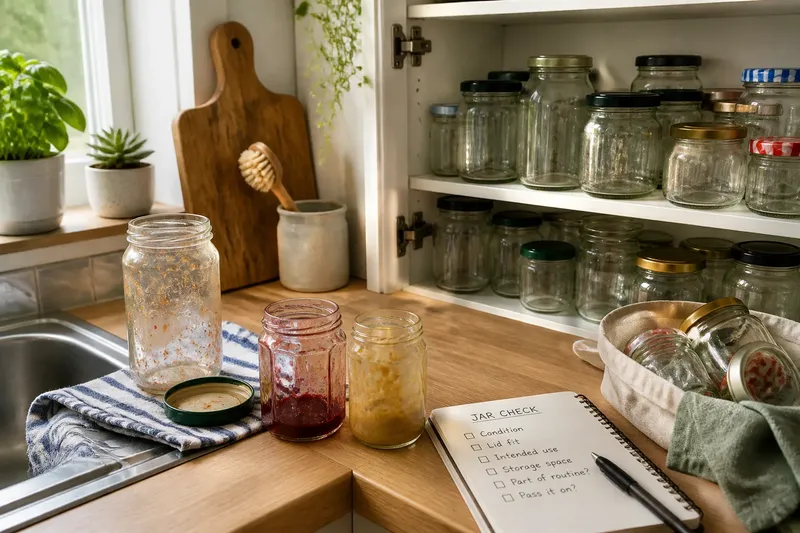
A rinsed pasta-sauce jar sits beside the sink while you dry the dishes. You set it aside for a future use, then do the same with a jam jar and a mustard jar whose lids have vanished. The jar collection trap begins when saving a container takes less thought than deciding what to do with it.
Imagine a household that reuses jars for packed lunches, craft supplies and pantry ingredients, but has no spare cupboard shelf. Keeping every container means the ones needed today are buried under the ones intended for some less specific occasion. The question is not whether jars are useful in general; it is which ones suit the routines and storage space you actually have.
The jar collection trap grows through unfinished decisions
A jar can be sound and still be surplus. It may have a chipped rim, a lid that no longer fits or a shape that makes it awkward to clean. Even an intact jar can become a nuisance if you must sort a stack each time you need a container.
Instead of treating reuse as a contest to save the most glass, ask what the jar would do and what it would take to keep it ready. That includes space, cleaning, checking the lid and remembering where you put it. A vague possibility does not become more practical by being stored for longer.
Check condition, fit and the way the jar will be used
Look at the glass, rim and lid before assigning a job. A damaged jar is not suitable for food storage, and a lid that sits loosely may not serve the purpose you have in mind. For food use, follow the manufacturer’s guidance and ordinary food-safety advice rather than assuming every jar is suitable because it once held food.
- Check the glass for chips or cracks; if it is damaged, do not reuse it for food and follow local disposal guidance, or choose an intact container instead.
- Check that a food-storage lid is present and fits as intended; if it does not, choose a different jar for that job or use the lidless jar only for a suitable non-food purpose.
- Check whether the opening is wide enough for the intended contents and cleaning; if access is awkward, choose a more suitable shape or pass the jar on.
- Check that the jar fits the cupboard or drawer where you will keep it; if it does not, choose another location only if it already has room, or release the jar.
- Check whether its intended use recurs in your routine; if you can name a real task, keep it for that task, but if the use is only a vague possibility, choose not to store it.
- Check whether a local group accepts spare jars before offering them; if it does, arrange the handover, but if it does not, use the appropriate local glass collection.
These checks are meant to settle a decision, not create a new sorting ritual. If a jar fails a condition check, do not leave it on the counter as a reminder to reconsider it later.
Choose jar uses that fit your household routines
Some jars are useful for dry ingredients, loose buttons, screws or pens. The right choice depends on the opening, lid, cleanliness and where the jar will live. A jar for pantry food needs different qualities from one holding craft supplies, so the first job is to name the use rather than collect a set of containers in search of one.
Say you have three clean jars: a broad one with a fitting lid, a narrow one without a lid and a small jam jar. You want a container for dry beans, somewhere to keep loose buttons and a place for pens. The broad jar suits the beans, the jam jar can hold buttons, and the narrow jar can hold pens if it is stable on your desk; if it tips easily, choose a mug already in use instead. You keep the two suitable jars, test the narrow one in its intended place, and route it to local glass collection if it is unstable. The result is a small group selected for real tasks, with a clear alternative for the jar that does not work.
How should you decide which jars to keep?
How many jars should I keep?
Keep only the number that fits the space you can spare and serves uses you can name. If the assigned cupboard space is full, use a jar you already own or let another one go rather than adding a second storage spot by default.
Can I reuse a jar without its lid?
Yes, for a purpose that does not require a lid, such as holding pens, provided the jar is stable and suitable for that use. If you want it for food storage or another covered purpose, choose a complete, suitable container instead.
Should I keep jars for occasional use?
Occasional use can justify keeping a jar when the task is familiar and the container is easy to retrieve. If the use depends on a routine you do not have, do not let the possibility alone take up space.
Where can I take spare jars?
Ask a nearby community kitchen, school, allotment group or reuse organisation whether it accepts them before taking a box over. If no local group wants them, follow your local glass collection guidance.
Make each incoming jar a small decision
When a new jar is empty, decide whether it will replace a jar you already keep, serve a distinct household task or leave the home. Wash and check it before storing it; otherwise, it can become another item whose future use depends on a later chore.
The jar collection trap is not solved by refusing every container or by keeping a perfect inventory. It is easier to see what is useful when each jar has a clear purpose, is safe for that purpose and has a sensible place. Search for the jar collection trap in your own cupboards by noticing which containers are ready for a real task and which are waiting on an unnamed one.
If your routines change, the decision can change with them. A new use is worth making room for when it has become part of ordinary household life, not merely because a jar happens to be available.