Why a Visible Landing Spot Helps Reusable Items Find Their Next Job
A visible landing spot for reusable household items makes useful things easier to remember, retrieve and pass on without letting storage become a pile.
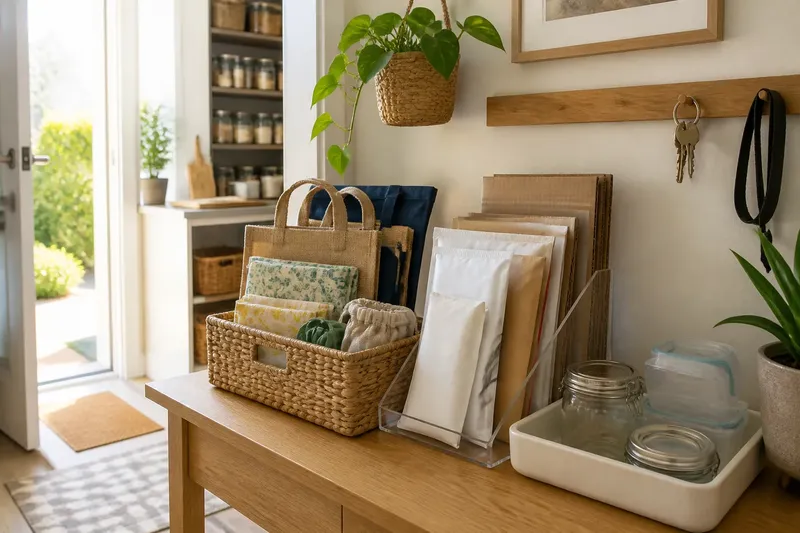
The spare gift bag is behind the cereal, the clean takeaway tub is on a shelf above eye level, and the bit of string is somewhere in a drawer with batteries. A visible landing spot for reusable household items gives these things a place between one use and the next, where they can be noticed before they are forgotten or multiplied.
The point is not to make a display of every object that might someday prove useful. It is to give a small number of genuinely reusable things a clear, temporary home and an obvious next destination. A landing spot should make action easier, not turn the kitchen into a museum of possible errands.
A landing spot is a pause, not a storage system
Reusable items often arrive in the home at awkward moments: a clean box after unpacking, a sturdy paper bag after shopping, a length of ribbon after opening a parcel. They are not rubbish, but their next use may not be immediate. Without a designated pause, they tend to drift towards whichever surface is available.
Choose a place that sits near the point where the item is likely to be used or passed on. A shallow tray near the front door may suit clean mailing materials intended for returns; a small basket beside the wrapping supplies may suit reusable gift bags. The location should be easy to see while doing the related task, rather than merely convenient to fill.
Keep the distinction clear: a landing spot is for items awaiting a known kind of next use, not for every object that seems too good to discard. If the spot is full, that is information. Use, pass on, or recycle what is there before adding more.
Visibility depends on the right kind of openness
“Visible” need not mean exposed across a worktop. A clear-fronted box, an open shelf at hand height, or a labelled shallow drawer can make contents legible without putting them on display. The useful test is whether you can recognise what is there during an ordinary routine, without moving a stack or opening several containers.
Containers should suit the contents. A small file holder can keep flat cardboard sleeves upright; a low-sided basket makes cloth ties easy to spot; a tray prevents a few reusable envelopes from sliding behind the post. A lidded box may be better for materials that need protection, but a lid adds a small act of effort. If opening it is the reason you forget what is inside, the arrangement is hiding the problem rather efficiently.
Labels help when the contents are not self-explanatory. “Clean jars for pantry storage” is more useful than “useful things”, which is also the sort of label that can defend almost anything. Name the next job, not the vague virtue of being reusable.
Give each category a boundary and an exit
A container provides a physical limit, but the category needs a practical one too. Keep only items that are clean, usable and suited to a likely household task. A bag with a broken handle does not become more reusable by joining a basket of good bags; it becomes a difficult decision with better company.
Set a simple capacity rule before the spot fills. For example, a tray might hold the few padded envelopes needed for likely returns, while anything beyond that is passed on or recycled. The exact limit depends on the household and the category. What matters is that “there is room” does not quietly become the only reason to keep something.
Give each item a route out as well as a place to wait. A reusable container might return to the cupboard after washing, go to a neighbour who wants it, or leave in the recycling if it is no longer serviceable. If no realistic next use comes to mind, the landing spot is probably acting as indefinite storage.
Put the place where the decision already happens
Reusables are easiest to manage when the landing spot is close to the moment of choice. Put reusable envelopes near the place where parcels are opened, not in a remote cupboard. Keep clean spare containers near the cupboard where they will be used, rather than beside the sink simply because they were washed there.
This does not mean every task needs its own basket. Too many dedicated locations create a memory exercise of their own. A single, well-placed spot can serve a narrow group of related objects, provided the contents remain easy to identify and the next action is compatible.
Say you regularly receive small parcels and sometimes send items back. Imagine placing a slim holder beside the post-opening area for clean, intact padded envelopes, with a rule that only envelopes in good condition and of useful sizes stay there. The visible supply may remind you to reuse one when packing a return; if the holder fills before that happens, the surplus has a clear decision attached rather than an invitation to start a second stash.
Check the landing spot during an existing routine
A landing spot needs attention, but not a new household ceremony. Look at it while putting away shopping, sorting post or preparing a parcel—whichever routine naturally meets the items. Check whether anything is ready to go back into use, whether something is waiting for a decision, and whether the container has reached its limit.
Keep the check brief and specific. “Do I have a next use for this?” is a better prompt than “Could this ever come in handy?” The second question is nearly impossible to answer honestly, because many things can be imagined into a future task. The first asks for a plausible destination in the household as it is.
If an item repeatedly sits untouched, adjust the system rather than treating it as a personal failing. The spot may be too far from the task, the category may be too broad, or the household may not need that material in the quantity being saved. Make the next decision visible: return it, give it away, or let it leave.
Which reusable items belong in a visible landing spot?
Should the landing spot be in the kitchen?
Only if the items are used or sorted there. Clean food containers may make sense near food storage, while parcel materials are more likely to be noticed near the place where deliveries are opened.
What if several people use the same items?
Choose a place everyone passes and label it by purpose, such as “clean containers to return”. A shared location is more useful than relying on one person to remember where the items were put.
How do I stop the spot becoming a pile?
Use a container with a clear capacity and decide what happens when it is full. Remove items that have no plausible next job instead of adding another container to preserve the first one’s contents.
Can a landing spot be hidden inside a cupboard?
Yes, if it is immediately recognisable and easy to reach. An open box at the front of a cupboard can work; a closed box behind unrelated supplies is less likely to remind anyone what it contains.
Keep the arrangement small enough to stay honest
A landing spot earns its place by shortening the distance between noticing an item and using it. It does not need matching containers, elaborate labels or a permanent claim on a prime surface. A tray, a basket or one clear shelf may be enough, as long as the contents have a shared purpose.
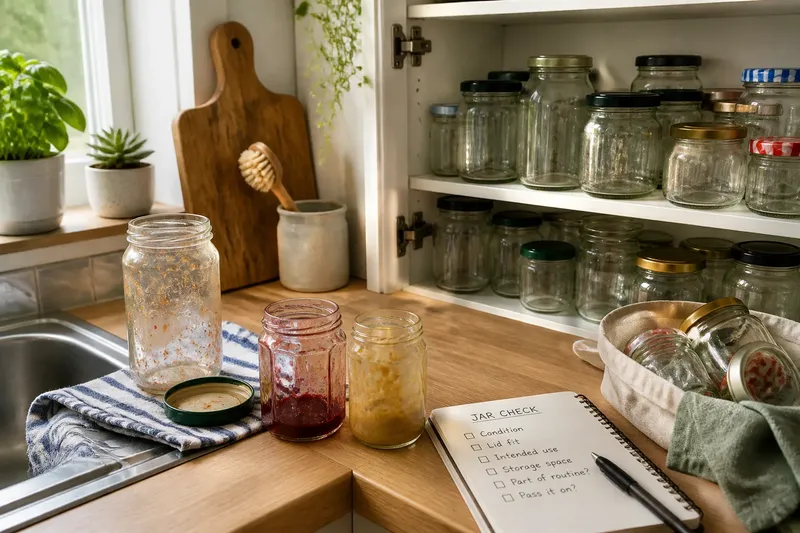
When deciding whether to keep an item, consider its condition, its likely next use and the space available for that category. A visible landing spot for reusable items is most helpful when it makes those decisions easier to see. Leave a little room for the next useful thing, but not so much that “temporary” becomes the household’s most spacious storage category.